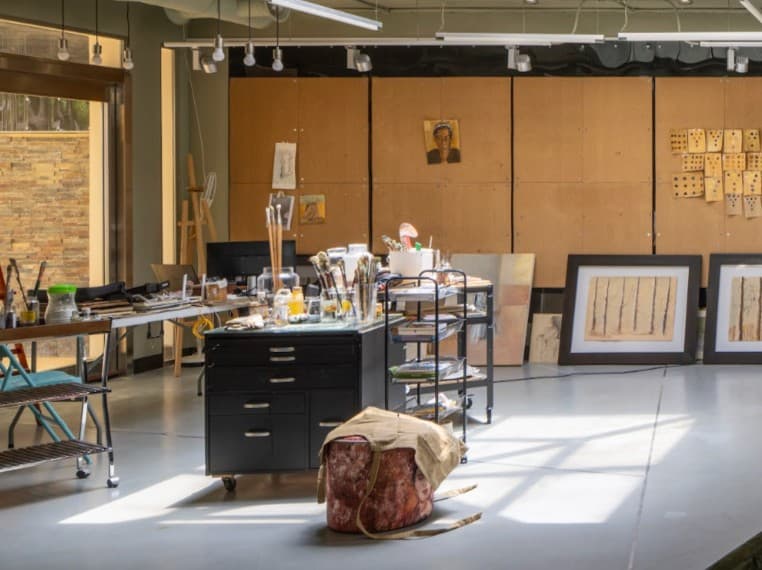
Studio
Hanan Bahamdan is a pioneering figure in Saudi art, recognised since her solo debut in 1991. She made history with Sotheby's sale of Mannci, the first work by a Saudi artist to be auctioned there, achieving three times its top estimate.
Bahamdan is a certified art therapist and runs a private studio in Riyadh, hosting workshops, lectures, and cultural events.
Artist's Statement
My journey with portrait painting is a soul’s journey that continuously develops with each sitter . The same chair sees endless perspectives of life. This started to bloom rapidly after Mannci, which went on to be one of my most notable works. The man in the portrait was a garbage collector . I would pass by him on the street but never truly acknowledge him; I felt sympathy towards him but knew nothing about him. In the late ’90s, I decided to ask if he would model for me, and he agreed. He was uncomfortable at first, but gradually as our connection grew, I could see through his body language that he was becoming more confident. I spent many sessions making preparatory drawings and studies of him, but when Mannci heard that an exhibition of mine was opening at The Opera in Cairo in 2005, he knocked on my studio door . With only a week until the exhibition opened, he insisted that I paint his portrait and include it in the show. He looked so pale and tired, but he was confident and determined; he had grown such strength since I first met him. So I took a chair out for him and prepared my paints – I use a lot of ochres, yellows and neutral earthy colours that inspired me from childhood weekends spent in the desert. The connection between Mannci and me was so strong at that moment that I painted a complete portrait of him there and then. At the time, I did not know how much Mannci was going to impact me. His portrait is a testament to the value of being seen, and how strongly connected that is to develop one’s soul and sense of self. It also became one of my most well-known works and the inspiration behind my ‘Forgotten Faces’ exhibition of 2009 in Riyadh. Mannci’s name means “forgotten” in Arabic, and to me, he sparked a desire to find the people who were often overlooked in society and place them somewhere they would finally be seen and acknowledged. It was as though looking into the soul of another progressed my soul on its own journey, from only knowing how to express raw emotions to allowing a therapeutic quality to evolve organically through my work. This is what brought up a need within me to search for an even deeper understanding of human psychology and behaviour with art. I then started studying Art Therapy in 2017 which enhanced my understanding of the significant role that portraiture plays in the therapeutic process. It also solidified my understanding of the painting process being extremely therapeutic for the sitter . The term ‘holding space’ is commonly used in therapy: it is the notion of creating a completely safe and comfortable environment for the client, free of judgement, where they will be actively listened to and communicated with. This idea underpins my artistic practice. My function is to make myself mentally and emotionally available for the soul in front of me. By preparing my soul to receive, I am creating a safe space for my clients. The traditional preparation of the pigments is extremely important in this regard. The physical act of grinding the pigments, methodically in a clockwise motion, engages my body and connects it with my mind and soul. Sometimes the sitters are also involved in that preparatory custom, which relaxes them and puts them at ease. By acknowledging the sitter’s emotional sensitivity, I create a comfortable environment and can foster a strong therapeutic alliance. My sitters often tell me that they feel as though they are leaving a therapy session after we finish a sitting and I, in turn, feel that looking into the souls of others has progressed my soul on its journey. What has fascinated me in my journey as an artist is the development of my sense of self, to realising that with each person who sat down in front of me, I was losing my ego. It was a cathartic shift from sympathy to empathy, to realizing the therapeutic aspect of portraiture. As a young woman growing up in Saudi Arabia, it was not possible for me to visit museums or attend art school, and there were no galleries. I took inspiration from the people around me and absorbed everything, building upon the desire to express everything through portraiture. This in itself was a challenge, as portraiture was not accepted as an artistic genre in Saudi Arabia for religious reasons. Not only this but being a female artist also presented its own set of challenges. I had to have my first exhibition in my own home in 1991, however, it had to be kept private. Over time, during the ‘90s and early 2000s, such restrictions were loosened, and there were more venues for exhibitions. A major development occurred in 2007 when Sotheby’s London included Mannci in their inaugural sale of Modern and Contemporary Arab and Iranian Art. It sold for over three times the estimate, garnering widespread interest that subsequently opened doors for other Saudi artists, particularly female artists. Then in 2010, Sotheby’s included another of my portraits, making me the first Arab artist in an International Contemporary Art Auction. Although progress has been made for female artists and the arts in general in Saudi, I always try to convey an element of tension and ambiguity in my works that speaks to the radical nature of what I am doing, and the cultural contradictions and barriers that I am trying to unravel. In my sitters’ faces, looking out from the canvas in quiet contemplation, I also see myself there and am reminded of the contemplations I was making when I created each work.
Biography
Hanan Bahamdan (born 1966) is a Saudi-born contemporary artist whose artistic career spans decades and continents. Hosting her first exhibition in the privacy of her own home during the restrictive 1990s Bahamdan went on to study and create studios in both Cairo, under the renowned Egyptian artist, Mohammed Sabri and at London's Heatherley School of Art, an independent college specialising in portraiture and figurative painting, returning to Saudi only a few years ago.
In 2007, she became the first female artist from the Kingdom to be offered in one of Sotheby's auctions, recognising the artist's commitment to readdressing the invisibility of women's work and to telling the stories of the marginalised.
Hanan Bahamdan's journey began in the 1990s, when she began to explore the human condition in private and through self-portraits, as many women throughout art history have done, as a powerful way to explore identity, challenge societal norms, and assert her presence. Ultimately, it is in these early days that Hanan begins to examine the power of art to heal, which led her to a practice that explores the interconnectedness of life and the ability of art to unite.
The artist's belief in art as a social prescription developed over the decades in Cairo and London, particularly in two of the artist's most significant and celebrated bodies of work, Forgotten Faces and Women in Boxes. In these works, Hanan invited people to sit for her over the course of weeks and months, including those she encountered on the streets and female friends and companions.
In the mid-'90s, the artist found herself walking Cairo's streets, captivated by the dignity of the marginalised people she found Hanan Bahamdan shared time and space with these "forgotten faces," telling their untold stories and giving them visibility. Hanan has a unique relationship with her sitters, forging a deep connection that results in portraits that go beyond likeness and physical presence, exploring instead the sitter's character and essence. The artist discusses how, in doing so, she reveals her own true nature.